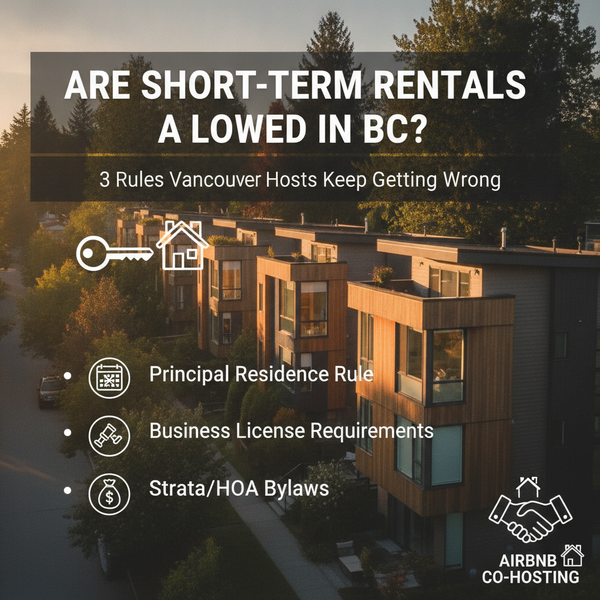
Strata vacation rental management in Vancouver means you need to follow three different rule systems at the same time.
- Your strata building's bylaws decide what you can and cannot do. Many Vancouver strata buildings have voted to ban short-term rentals completely.
- The City of Vancouver requires you to get a Short-Term Rental Registration (STRR) licence before you list any vacation rental from your condo.
- BC passed the *Short-Term Rental Accommodations Act* (STRAA). It became law on May 1, 2024. This is a province-wide rule that sits on top of the local rules.
- The City of Vancouver can fine operators without a licence. BC imposes significant penalties for breaking the STRAA, with individual fines substantially exceeding those imposed by the City, and corporate fines even higher.
- AirDNA's 2024 data shows whole-apartment listings in areas like Yaletown and Coal Harbour command premium nightly rates. Most of these listings maintain steady year-round booking demand. Your results will depend on your specific unit and location.

Getting all three right at the same time is what separates a legal money-making rental from one that gets shut down.
---
TL;DR
- | Factor | Details | |--------|---------| | Principal residence rule | The unit must be your main home — both the City and province require this | | Strata permission | Your building's bylaws must…
- Most Vancouver condo owners skip this step.
- The City of Vancouver created the Short-Term Rental Registration (STRR) programme in 2018.
- In November 2023, BC passed the Short-Term Rental Accommodations Act (STRAA).
Quick-Reference: Vancouver Strata STR Compliance at a Glance
---
Check 1: Has Your Strata Actually Voted to Allow Short-Term Rentals?
Most Vancouver condo owners skip this step. They think that if the City allows short-term rentals, their building must allow them too. This is wrong — and it can cost you a lot of money.
The BC *Strata Property Act* (SPA) lets strata corporations make bylaws that block or ban business activity in residential units. A strata council can vote to ban short-term rentals. Many have. Once the bylaw vote passes and gets registered with the Land Title and Survey Authority (LTSA), that rule becomes binding on all owners. It doesn't matter if you have a City licence or an Airbnb listing. It doesn't matter what you agreed to when you bought. The bylaw rules your building now.
The vote percentage is important. Under the SPA, changing strata bylaws needs a supermajority of owners to vote yes at an Annual General Meeting or Special General Meeting. Once passed and registered at the LTSA, it applies to every owner immediately.
Since BC passed its provincial STR law in late 2023, many Vancouver strata buildings have updated their bylaws. Some had strict rules already. Others moved quickly once the province made its direction clear. The pattern across Metro Vancouver is the same: more strata buildings are adding STR restrictions, not removing them.
> "One of the most common misconceptions we hear from strata owners is that holding a municipal short-term rental licence means they're fully compliant. What they often don't realize is that their strata corporation's bylaw is a completely separate legal obligation — and it takes precedence inside the building regardless of what the City permits." — Tony Gioventu, Executive Director, Condominium Home Owners Association of BC (CHOA)
How to check your strata's rules before you list:
Call your strata management company or your strata council and ask to see your building's current bylaws. Ask specifically about short-term rental restrictions. Look for language about "rentals under 30 days," "vacation rentals," or "short-term rentals." If the wording isn't clear, email the strata council chair and ask for a written answer before you do anything else.
You can also search BC Online at the Land Title and Survey Authority (ltsa.ca) for registered bylaw changes to your building. This database shows all the registered changes to your strata's bylaws, including any recent updates after the provincial STRAA passed.
Get it in writing before you list. An email from your strata manager is fine. If they say "I think it's probably okay," that's not confirmation — you're taking the risk yourself.
Running an STR in a strata that bans it can result in fines from your corporation. Strata corporations can set violation fines through their bylaws. The amount varies by building and board. The strata can also get a court order to force you to stop. A City of Vancouver STRR licence won't protect you from your own strata's rules.
---
Check 2: Does Your Vancouver Condo Qualify for a STRR Licence?
The City of Vancouver created the Short-Term Rental Registration (STRR) programme in 2018. It was one of Canada's first formal STR licensing systems.
The main rule has not changed: the unit you rent must be your principal residence.
This rule matters more than it sounds. Your principal residence is where you live most of the year. This is the address on your BC driver's licence, your tax return, your bank statements, and your personal mail. The City checks STRR applications against BC Assessment records and driver's licence data. This isn't just paperwork — it's a real check.
You cannot run a licensed STR in a second property or an investment condo you own but don't live in. You cannot run it in a unit you've left, even for a short time. If your life changes — a long work trip abroad, moving for family, or a relationship change — the principal residence test may no longer apply to your unit.
What you need for the STRR application:
- Government-issued photo ID
- Proof you live there: a utility bill, bank statement, or BC driver's licence with the unit address
- Your strata lot number
- Written proof that your building allows STRs, if your bylaws require it
The City of Vancouver requires an annual STRR licence fee. The City checks each application against the principal residence requirement before it issues a licence number.
Platforms have their own rules. Airbnb and VRBO must show your STRR licence number on every active listing. Listings without a valid licence are flagged for removal under the City's agreements with these platforms. The City checks platform listings against its licence database on a regular schedule. Unlicensed listings have been removed and their owners fined.
Professional co-hosting in Vancouver handles this for you — not just once at the start, but at each annual renewal.
---
Check 3: What Did BC's Short-Term Rental Accommodations Act Change for Strata Owners?
In November 2023, BC passed the *Short-Term Rental Accommodations Act* (STRAA). It became law on May 1, 2024. It's the biggest change to BC's STR rules in years.
Here's what changed — and what stayed the same.
What changed:
The principal residence rule is now provincial law. Before May 2024, it was only a Vancouver City policy. Under the STRAA, it applies to larger BC communities. For Metro Vancouver — whether you're in Vancouver, Burnaby, Richmond, or North Vancouver — the rule now has two enforcement layers: the City and the province.
Platforms now have new responsibilities. The STRAA requires short-term rental platforms — Airbnb, VRBO, and others — to send host information to the province every month. This is mandatory. Platforms that don't follow this rule face their own penalties. This creates a central STR list that BC Housing uses to check for violations. There's no longer a gap between what you do on a platform and what the province knows.
Fines are serious. Individuals who break the STRAA face substantial penalties. Companies — including numbered companies and holding entities — face major corporate penalties. BC Housing handles enforcement. The City of Vancouver also has its own penalty power for operations without a licence.
This matters especially for owners who set up an STR through a numbered company to avoid the principal residence rule. That approach doesn't work under the STRAA.
What stayed the same:
Your strata bylaw still applies. The STRAA gives cities and the province stronger enforcement tools, but it doesn't override a strata corporation's right to ban STRs under the BC *Strata Property Act*. If your building voted to ban short-term rentals, the province's law doesn't change that vote.
The City of Vancouver's STRR licence requirement still applies separately. You need three things at once: a strata bylaw that allows STRs, a valid City STRR licence, and compliance with the provincial STRAA. The STRAA is an extra layer, not a replacement for the local rules.
Keeping up with all three is a core part of what Vancouver strata co-hosting covers — watching for rule changes and alerting you to changes that affect your listing before they become violations, not just checking boxes at the start.
---
Check 4: What Revenue Can a Compliant Strata STR in Vancouver Realistically Generate?
Following the rules isn't just about avoiding fines. It's about protecting an income stream that's worth protecting.
AirDNA tracks short-term rental market data across North America, including Metro Vancouver. Their 2024 data for Vancouver whole-apartment strata listings shows strong occupancy in Downtown, Yaletown, and Coal Harbour. Premium nightly rates characterize listings in these central locations. Yaletown and Coal Harbour listings command the highest rates in the Metro Vancouver market.
The neighbourhood you choose has a big effect on both how often your place books and how much you can charge. Not all Metro Vancouver strata markets perform the same way year-round.
*Sources: AirDNA Metro Vancouver market data, 2024. These are market rates for whole apartments in each area. How well your unit does depends on size, condition, amenities, view, and listing quality. Actual results vary.*
Dynamic pricing is the biggest single way to increase revenue. A flat nightly rate set in January and never changed brings in much less money than the Vancouver STR market could offer. Listings that change their price every day — based on real-time platform demand, Vancouver's event schedule at Rogers Arena and the Vancouver Convention Centre, what similar units charge, and seasonal patterns — bring in more total revenue across the year. Professional listings typically outperform comparable listings with fixed prices in total annual revenue.
This is where professional strata vacation rental management often makes the biggest measurable difference in your net revenue. STR management fees vary based on services — check our pricing page for what's included. For any strata owner, the real question is: what's your net revenue after paying for management compared to what you'd realistically make on your own — while also handling compliance, pricing, guest messages, and turnovers yourself, and taking on all the regulatory risk alone?
---

Check 5: What Happens When Your Strata Bylaw, Your Licence, and Your Operations All Collide?
This is where strata vacation rental management gets complex. It's not three separate problems. It's one system with three separate ways it can fail — any one of which can shut down a legal, profitable listing with little warning.
The most common problem: a strata owner has a valid STRR licence, a clean listing, and a building that allows short-term rentals. Then the strata council calls a Special General Meeting. One motion. A supermajority vote. Suddenly the building bans rentals under 30 days.
Your STRR licence doesn't protect you from this. Your platform listing doesn't protect you. Money you've already collected doesn't protect you. The strata corporation can send you violation notices right away and get a court order to force you to stop.
Three collision points that need continuous management, not just a one-time setup:
Bylaw changes. Strata bylaws can change at any Annual General Meeting or Special General Meeting. If you don't watch the agenda notices, you can miss a vote completely. Many owners first find out about a bylaw change when they receive a formal violation notice. Watching AGM agenda notices for STR-related motions — before the vote, not after — is a standard service of professional co-host management.
Licence renewal. STRR licences last one year. Each renewal requires proof that you still live there as your main home. If your circumstances change — a long work project abroad, a relationship change, or a move for a new job — the principal residence test may no longer apply to your unit. Operating on an expired or non-qualifying licence is the same as operating without one legally. The City checks licence status against active platform listings.
Guest incidents in strata buildings. Strata buildings have noise rules, amenity booking systems, visitor parking rules, and elevator access rules. An STR guest who breaks any of these can trigger a formal complaint to the strata corporation about your unit. Repeated complaints hurt your standing with the strata corporation — and, in serious cases, your ability to keep operating an STR in that building.
This is what makes strata STR management different from renting a house. Your guest's behaviour doesn't just affect your review score — it affects your relationship with the strata corporation and your ability to list.
Professional co-hosting for Vancouver strata owners handles this with systems and procedures. Guest pre-arrival messages include your building's specific rules: quiet hours, no-party policies, amenity booking procedures, visitor parking allocation, and elevator access instructions. House manuals are made for each building individually. When something goes wrong with a guest, it gets fixed fast and documented before it reaches the strata council.
---
What Does a Professional Strata Co-Host Do That a DIY Host Can't Match?
There are things an experienced co-host does that a first-time DIY host can't realistically copy. The difference isn't secret knowledge — it's time, systems, and Vancouver-specific expertise from working across multiple strata buildings in multiple neighbourhoods.
Dynamic pricing that moves with the market:
A flat rate set in January and left unchanged through summer brings in much less money than the Vancouver STR market could offer. Professional co-hosts use dynamic pricing tools that connect to real-time demand data, Vancouver's event schedule — Rogers Arena concerts, Vancouver Convention Centre events, local festivals and sports — and what competitors charge on the platform. Nightly rates need to change with demand. They won't if you set them once and forget them.
Compliance monitoring that continues after setup:
STR compliance isn't a one-time checklist. Strata bylaws change. The City updates its STRR guidance. BC's STRAA became law in May 2024 and enforcement continues to develop as BC Housing builds out its registry and inspection programme. A professional co-host watches for regulatory changes and alerts you to changes that affect your listing before they become violations.
Building-specific guest communication:
Strata buildings aren't hotels. Guests need to understand your building's rules before they arrive: quiet hours, no-party policies, how to book the amenity room, where visitor parking is, and elevator access rules. A co-host puts your building's specific rules into every pre-arrival message. Guests arrive informed. Formal strata incidents happen much less often as a result.
Professional turnovers and maintenance:
A strata unit with strong booking demand needs a professional turnover process: scheduled cleaning crews, a reliable linen and supply system, and a maintenance plan that catches problems early. A broken door latch reported right away is a maintenance issue. A broken door latch found by the strata property manager's routine inspection is a violation on record. The difference matters for your standing with the corporation.
Multi-municipality coverage across Metro Vancouver:
CinCin YVR CoHost works with strata owners in Vancouver, Burnaby, Richmond, North Vancouver, and Coquitlam. Each municipality has its own STR licensing rules layered over the provincial STRAA. A Richmond strata unit operates under different municipal licensing rules than a Vancouver unit. A unit in the District of North Vancouver has different rules than one in the City of North Vancouver. Getting these details right at the start protects your investment, your listing, and your building standing.
---
在溫哥華公寓短租管理的五個關鍵要點 | Key Points for Strata Owners
溫哥華公寓短租(短期租賃管理)涉及三個獨立的法規框架,每一層都必須同時符合要求:
1. 卑詩省物業管理條例(BC Strata Property Act) 公寓法人可透過業主大會以超多數票通過修改附例,禁止短期租賃。決議一經土地局(LTSA)登記,即對所有業主具有法律約束力。持有市政短租牌照並不能豁免您對本大廈附例的遵守義務。
*The strata corporation can vote to ban STRs with a supermajority. Once registered with the LTSA, the bylaw is binding on all owners — including those with valid City STRR licences.*
2. 溫哥華市短期租賃登記牌照(STRR Licence) 您的單位必須是您的主要居所。年費由溫哥華市規定(2024年)。Airbnb 及 VRBO 必須在所有 listing 上顯示有效牌照號碼。未領牌照的業主面臨市政罰款。
*Your unit must be your principal residence. STRR licence fee applies annually (2024). Platforms must display your licence number on every active listing. Unlicensed operators face penalties from the City.*
3. 卑詩省《短期租賃住宿法》(STRAA,2024年5月1日生效) 違規個人和企業均面臨重大罰款;企業(包括無限公司)罰款尤為嚴厲。各平台每月須向省政府提交業主數據。透過公司架構規避主要居所要求在此法例下已不再有效。
*Individual and corporate violations carry significant penalties, with corporate penalties being substantially higher. Monthly platform data reporting to the province is mandatory. Corporate ownership structures no longer exempt strata owners from the principal residence requirement.*
根據 AirDNA 2024年數據,溫哥華耶魯鎮(Yaletown)及煤港(Coal Harbour)整套公寓短租具有強勁市場表現。
了解 CinCin YVR CoHost 的完整服務詳情。
---

Test Your Knowledge
1. How many separate regulatory frameworks must Vancouver vacation rental operators comply with?
- A. Just the City of Vancouver Short-Term Rental Registration
- B. Strata bylaws and City registration only
- ✅ C. Strata bylaws, City registration, and BC provincial law
- D. Only the BC Short-Term Rental Accommodations Act
*The article identifies three independent rule systems: building bylaws, the City's STRR licensing requirement, and BC's STRAA provincial law enacted May 1, 2024.*
2. What supermajority voting requirement applies to passing strata bylaws that restrict short-term rentals?
- A. A simple majority of owners
- B. Two-thirds of owners
- ✅ C. A supermajority vote requiring substantial owner agreement
- D. Unanimous approval from all owners
*The article states that under the BC Strata Property Act, changing strata bylaws requires a supermajority vote at a general meeting.*
3. What residency requirement applies to a condo unit being rented out as a vacation rental in Vancouver?
The unit must be the owner's principal residence (main home), not an investment property, according to both City and provincial requirements.
4. Describe two methods a condo owner can use to verify whether their building permits short-term rentals.
They can contact their strata management company or council to request the current bylaws, or search the BC Online Land Title and Survey Authority (LTSA) database to review registered bylaw changes for their building.
FAQ
How is a strata bylaw restriction on STRs different from the City of Vancouver STRR licence?
These are two completely separate requirements that work independently. Your strata bylaw is set by your strata corporation under BC law. It can ban short-term rentals inside your building no matter what the City allows. The City's STRR licence is a permit from the City of Vancouver. You need both at the same time: a strata bylaw that allows STRs and a valid City STRR licence. A valid City licence doesn't override a restrictive strata bylaw. And an open strata bylaw doesn't replace the City licence requirement.
Can I operate a strata STR through a numbered company to work around the principal residence rule?
No. BC's Short-Term Rental Accommodations Act, which became law in May 2024, applies to both individuals and corporations. Operating through a numbered company or holding entity doesn't exempt you from the principal residence requirement. Corporate violations also carry substantially higher penalties than individual violations.
How does a professional co-host prevent guest incidents from becoming formal strata complaints?
A professional co-host puts your building's specific rules into every guest touchpoint before and during the stay. Pre-arrival messages, digital house manuals, and check-in guides are all tailored to your specific strata: quiet hours, no-party policies, amenity booking procedures, visitor parking allocation, and elevator access instructions. When a guest issue happens, it's fixed quickly and documented before it reaches the strata council. This is much faster and less damaging than a DIY host receiving a formal violation notice weeks later.
Which Vancouver neighbourhoods perform best for strata short-term rental management?
AirDNA's 2024 market data shows Yaletown, Coal Harbour, and central Downtown Vancouver produce the strongest rates for whole-apartment strata listings. These typically command premium nightly rates with steady year-round demand. Burnaby's Brentwood and Metrotown areas show steady year-round occupancy at lower rates. North Vancouver's central Lonsdale corridor performs well during summer months. The right neighbourhood depends on your unit's size, condition, and how close it is to Vancouver's main demand areas. AirDNA data is a starting point, not a guarantee. Individual listing quality makes a big difference in any neighbourhood.
What happens to my STRR licence if my strata votes to ban short-term rentals after I've already been operating?
Your City STRR licence doesn't disappear, but you can't use it in that building from the date the bylaw amendment takes effect. The licence allows you to operate an STR in your principal residence. If your strata bylaw bans it, you can't operate legally in that building no matter what your municipal permit says. You need to stop operations right away and contact the City about your licence status. Continuing to operate after a strata ban takes effect exposes you to strata fines and possible court action. This is exactly why watching strata AGM agenda notices before votes happen — not after — is a core function of professional co-host management. --- CinCin YVR CoHost works with Vancouver strata owners across Yaletown, Coal Harbour, Downtown, Burnaby, and North Vancouver. Our team knows this regulatory environment in detail. We understand the strata bylaws, the STRR licence process, and the operational systems that protect your income and your building standing. Explore our full service offering or visit our pricing page to see what's included. ---