
Rental Properties for Passive Income Playbook: Making Properties Work for You
Why Rental Properties for Passive Income Are More Complex Than You Think
Rental properties for passive income remain one of the most sought-after investment strategies, especially as more than half of Americans plan to set a financial resolution for the new year. But here’s the truth: the term “passive” can be misleading.
Quick Answer: How Passive Are Rental Properties Really?
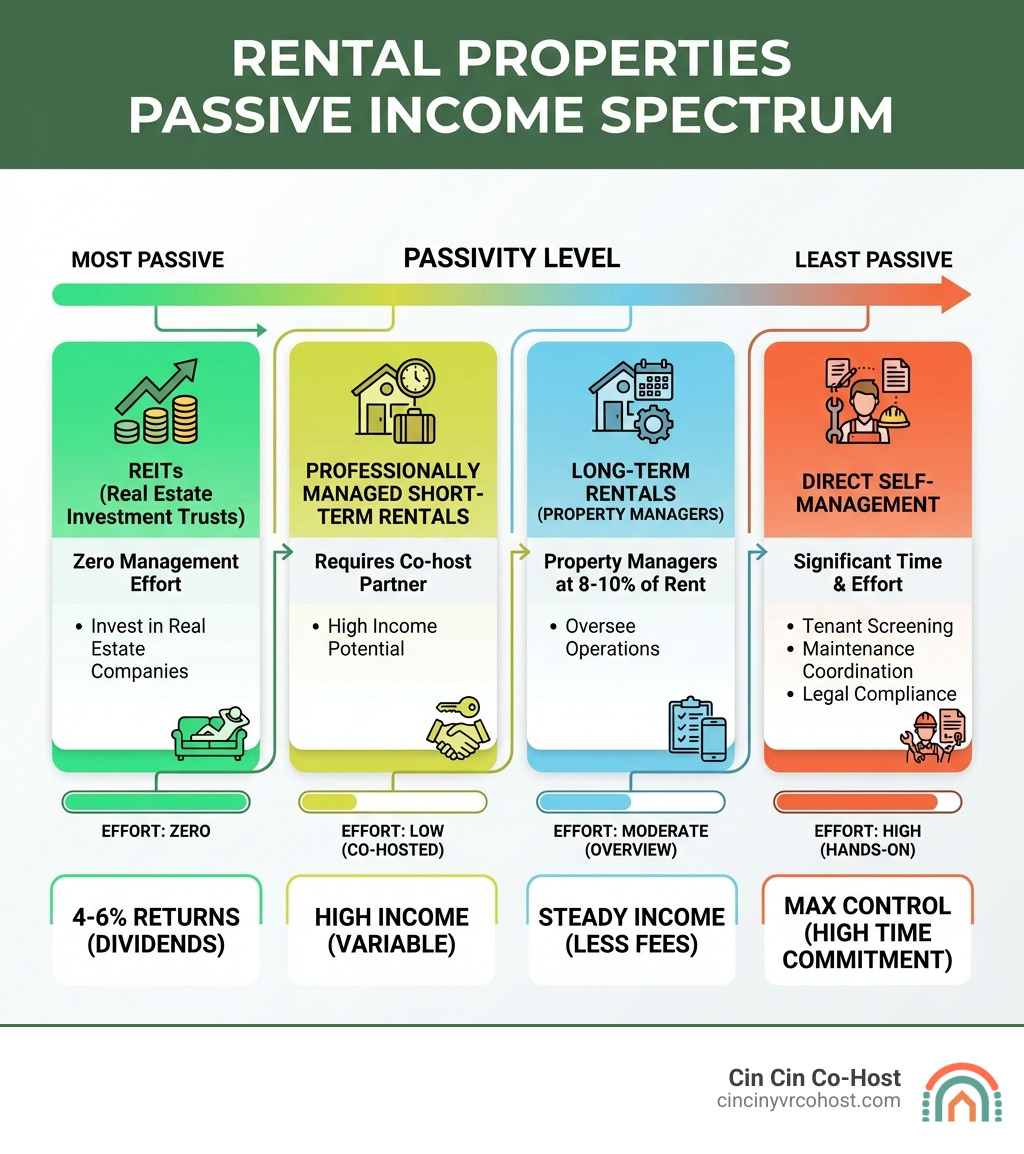
- Direct Ownership: Requires active management (tenant screening, repairs, legal compliance) – only truly passive if you hire a property manager (8-10% of rent)
- Short-Term Rentals (Airbnb): High income potential but intensive management – best with professional co-host services
- REITs: Genuinely passive – invest in real estate companies, earn 4-6% dividends, zero management required
- Best ROI: Target 8-12% cash-on-cash return for direct ownership; 10-15% total ROI
- Entry Cost: $0-3.5% down for owner-occupied multi-family; 15-25% for investment properties; as low as $100 for REITs
The reality is that rental income sits on a spectrum. On one end, you have Real Estate Investment Trusts (REITs) that require zero effort beyond buying shares. On the other end, you have direct property ownership that can demand significant time for tenant management, maintenance coordination, and legal compliance – unless you hire professional help.
Many property “gurus” promote rental properties as a set-it-and-forget-it income stream. The truth? Even with a property manager, landlords remain liable for their agent’s mistakes, must oversee operations, and need to understand landlord-tenant laws. As one experienced landlord put it: “Calling rental income ‘passive’ is dangerous as it downplays the risks and responsibilities involved in providing housing.”
The good news? With the right strategy, rental properties can generate substantial passive income. It’s about choosing the investment path that matches your capital, time availability, and involvement preference.
As CinCin YVR Co-host, I’ve helped Vancouver property owners transform their short-term rentals into truly passive income streams through professional co-hosting services that handle everything from guest communication to dynamic pricing optimization for rental properties for passive income. My background in interior design from Emily Carr University combined with operational expertise allows me to maximize both the aesthetic appeal and profitability of every listing I manage.
Choosing Your Investment Path: A Comparison of Rental Property Types
When we consider rental properties for passive income, the first step is to align our investment goals with the various types of rental properties available. Each option comes with its own set of upfront costs, management efforts, income potential, and scalability, influencing how “passive” your income truly becomes. Our risk tolerance and how beginner-friendly an option is also play a crucial role in making the right choice.

Let’s compare the most common paths to real estate investment for passive income:
| Investment Type | Upfront Cost | Management Effort | Income Potential | Scalability |
|---|---|---|---|---|
| Single-Family Homes | High | Moderate to High (if self-managed) | Moderate | Slower (one property at a time) |
| Multi-Family Homes | High | Moderate to High (if self-managed, but economies of scale) | Moderate to High | Faster (multiple units in one purchase) |
| Short-Term Rentals (Airbnb) | Moderate to High | Very High (if self-managed); Low (with professional co-host) | Very High | Moderate (can add more units, but management scales linearly) |
| REITs | Low | Very Low (truly passive) | Moderate | Very High (buy more shares easily) |
Single-Family & Multi-Family Homes
Investing in traditional residential properties, whether single-family homes or multi-family units like duplexes or small apartment buildings, has long been a cornerstone of wealth building. These types of rental properties for passive income offer several compelling advantages:
- Appreciation: Over the long term, real estate in desirable areas like Vancouver, Burnaby, Richmond, or North Vancouver tends to appreciate in value. This means your asset grows, building equity beyond just rental income.
- Tenant Stability: Long-term tenants in single-family homes often stay for years, reducing turnover costs and vacancy periods. Multi-family units can offer a buffer against vacancy risk; if one unit is empty, you still have income from the others.
- Control: As the direct owner, you have full control over property management, renovations, and tenant selection (within legal bounds).
- Tax Benefits: While we can’t provide specific tax advice for Canada, property owners typically benefit from various deductions related to expenses and, in some cases, depreciation, which can significantly reduce taxable income. We always recommend consulting with a local tax professional in British Columbia.
However, direct ownership comes with its drawbacks:
- Vacancy Risk: A vacant property means zero income but ongoing expenses (mortgage, taxes, insurance).
- High Entry Cost: Acquiring a property in Metro Vancouver requires a substantial down payment, typically 15-25% for investment properties. While owner-occupied multi-family properties might qualify for lower down payments, it’s still a significant capital outlay compared to other investment types.
- Management Effort: Even with good tenants, managing these properties involves responding to maintenance requests, handling lease renewals, and ensuring compliance with the Residential Tenancy Act in British Columbia.
Short-Term Rentals (e.g., Airbnb)
The rise of platforms like Airbnb has opened up a new avenue for rental properties for passive income, especially in high-demand tourist destinations like Vancouver.
- High Revenue Potential: Short-term rentals often command higher nightly rates than long-term leases, leading to significantly higher gross income, particularly in prime locations such as downtown Vancouver, Kitsilano, or near popular attractions.
- Flexibility: Owners can use the property themselves when it’s not rented out, offering a blend of personal use and income generation.
- Dynamic Pricing Strategies: Utilizing tools and expertise for dynamic pricing strategies can maximize booking rates and revenue, adapting to seasonal demand and local events.
But this comes with unique challenges:
- Intensive Management: Short-term rentals are often far from “passive” if self-managed. They require frequent cleaning, guest communication, check-ins/check-outs, and maintenance coordination. The effort is akin to running a small hotel.
- Regulatory Problems: Municipalities across Metro Vancouver (like Vancouver, Richmond, and Burnaby) have specific bylaws and licensing requirements for short-term rentals. Navigating these can be complex and time-consuming.
- High Turnover: More guests mean more wear and tear, more cleaning, and a constant need for guest services, which can be exhausting for a solo host.
This is precisely where professional co-hosting services, like ours at CinCin YVR Co-host, become invaluable. We handle all the intensive day-to-day operations, changing your short-term rental into a truly passive income stream.
Real Estate Investment Trusts (REITs)
For those who want exposure to real estate without the direct responsibilities of property ownership, Real Estate Investment Trusts (REITs) are an excellent option for rental properties for passive income.
- Low Entry Cost: You can invest in REITs with as little as a few hundred dollars, making it accessible to a wide range of investors.
- True Passivity: You buy shares in a company that owns and manages a portfolio of income-producing real estate. There’s no tenant interaction, no maintenance calls, and no legal headaches.
- Diversification: REITs often own diverse portfolios across different property types (e.g., residential, commercial, industrial) and geographies, reducing risk compared to owning a single property.
- Dividend Income: REITs are legally required to distribute a significant portion (at least 90%) of their taxable income to shareholders as dividend income. For example, Invitation Homes (INVH), a single-family rental REIT, has a dividend yield of 4.3%, while Realty Income (O), which invests in commercial properties with net leases, currently yields 5.7% and has a history of increasing its monthly dividend (133 times since 1994!).
The downsides are primarily related to control and market dynamics:
- No Direct Control: You have no say in which properties are bought or sold, or how they are managed.
- Market Volatility: REIT share prices can fluctuate with the broader stock market, meaning your investment value can go up and down.
The Reality of “Passive”: Management Strategies and Tax Considerations
The dream of rental properties for passive income often clashes with the reality of direct ownership. While the idea of collecting rent checks without lifting a finger is appealing, the path to true passivity usually involves strategic delegation and understanding the nuances of management and local regulations.

The primary drawbacks of directly owning rental properties for passive income often stem from the active involvement required. Tenant issues can range from late payments to property damage or even eviction proceedings. Unexpected repairs, whether a leaky roof or a malfunctioning furnace, can arise at any time, demanding immediate attention and financial outlay. Without proper management, a rental property can indeed turn from a money-maker into a money pit.
Self-Management vs. Hiring a Professional
The choice between managing your rental property yourself or hiring a professional property manager is a pivotal one that defines how passive your income will be.
Self-Management
- Pros:
- Cost Savings: You save the 8-10% of rent that a property manager would typically charge.
- Direct Control: You have complete oversight of tenant selection, maintenance decisions, and rent collection.
- Cons:
- Time-Consuming: This is the opposite of passive. You’re responsible for advertising vacancies, screening tenants, collecting rent, handling maintenance requests, dealing with emergencies, and managing legal compliance with British Columbia’s Residential Tenancy Act.
- Landlord-Tenant Laws: Navigating complex and ever-changing landlord-tenant laws in BC requires significant effort and knowledge. Mistakes can be costly.
- Stress: Dealing with difficult tenants, unexpected repairs, and legal disputes can be incredibly stressful.
Hiring a Property Manager
- Benefits:
- Truly Passive Potential: A good property manager handles the day-to-day operations, making your income stream genuinely passive. They manage everything from finding and screening tenants to handling maintenance and rent collection.
- Expertise: Professional property managers bring expertise in local market conditions, landlord-tenant laws, and effective property maintenance.
- Cost-Effective (in the long run): While they typically charge 8-10% of the monthly rent (plus a leasing fee), they can often save you money by reducing vacancy rates, ensuring proper tenant screening, and negotiating better deals with contractors. For short-term rentals, specialized co-hosts offer expert handling of guest issues, dynamic pricing, and marketing, which translates to maximized revenue.
For our clients in Vancouver, Metro Vancouver, and surrounding areas who invest in short-term rentals, we emphasize that professional co-hosting is the key to open uping true passivity and maximizing returns. It transforms a highly active venture into a hands-off, profitable one.
The Truly Passive Alternative: Investing in REITs
If your goal is absolute passivity with minimal effort, investing in REITs remains a strong contender. As discussed, these publicly traded companies allow you to invest in real estate portfolios without any direct management responsibilities.
For example, Invitation Homes (INVH) specializes in single-family rental properties, offering investors a 4.3% dividend yield. Realty Income (O) focuses on commercial properties, often secured by long-term net leases with major corporations. It provides a 5.7% yield and has a remarkable track record of increasing its monthly dividend consistently. These examples illustrate how REITs provide predictable income without the operational demands of direct property ownership.
Understanding Tax Considerations for Rental Income in British Columbia
While our research contains information on IRS rules, it’s crucial for our clients in British Columbia to understand the Canadian tax landscape. For rental properties for passive income in Vancouver and across BC, rental income is generally considered taxable income. However, many expenses incurred to earn that income are deductible, which can significantly reduce your taxable earnings. These typically include:
- Mortgage interest (on the portion of the loan used for the rental property)
- Property taxes
- Property insurance
- Utilities (if paid by the landlord)
- Maintenance and repairs
- Property management fees
- Advertising costs for tenants
- Travel expenses to inspect the property
- Capital Cost Allowance (CCA), which is Canada’s equivalent to depreciation, allowing you to deduct a portion of the capital cost of the building (but not the land) each year.
It’s important to keep meticulous records of all income and expenses. We strongly advise consulting with a qualified Canadian tax professional or accountant in British Columbia to ensure you are compliant with all federal and provincial tax laws and to maximize your deductions.
Maximizing Profitability from Rental Properties for Passive Income
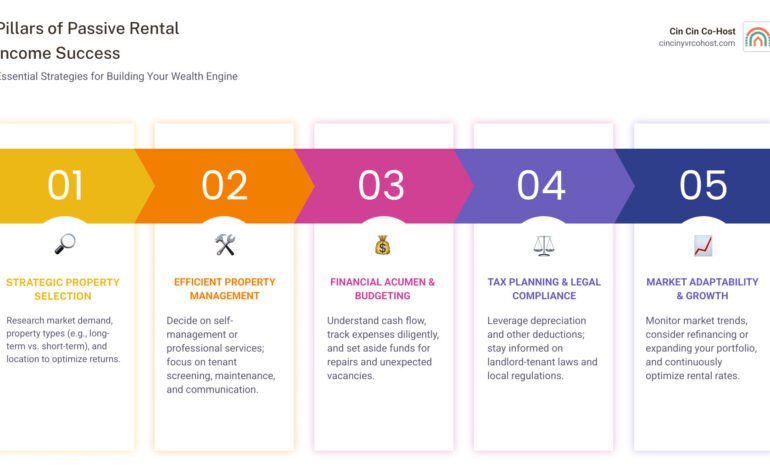
For those committed to direct ownership of rental properties for passive income, understanding and applying sound financial principles, strategic location analysis, and effective expense management are paramount. This is where the “passive” part of the equation truly becomes a result of smart, upfront work.
Key Financial Metrics to Calculate Profitability
Before diving into any investment, we must crunch the numbers. Here are the essential metrics we use to evaluate the potential profitability of rental properties for passive income:
- Cash Flow: This is the tangible cash left over each month after all operating expenses (mortgage, taxes, insurance, maintenance, property management fees) are paid. Positive cash flow is the bread and butter of passive income.
- Return on Investment (ROI): ROI measures the overall profitability of an investment relative to its cost. For rental properties, it’s generally recommended to aim for an ROI of 10-15%.
- Cash-on-Cash Return (CoC): This metric specifically measures the annual pre-tax cash flow generated by the property relative to the actual cash invested (down payment, closing costs, initial repairs). We advise striving for a Cash-on-Cash Return yielding between 8% and 12%. This is a great indicator of how well your initial capital is performing.
- Capitalization (Cap) Rate: The cap rate is the ratio of a property’s Net Operating Income (NOI) to its current market value. It’s often used to compare similar income-producing properties and quickly estimate potential return.
- The 1% Rule: This is a quick guideline stating that the monthly rent should be at least 1% of the total purchase price of the property. For example, a $500,000 property in Surrey should ideally rent for at least $5,000 per month. While a simple rule, it helps in initial screening of potential deals.
How to Choose the Best Location for Your Investment
Location, location, location! This timeless real estate adage is especially true for rental properties for passive income. The right location in British Columbia can ensure consistent tenant demand, higher rents, and better property appreciation. When evaluating areas like Vancouver, Coquitlam, Langley, or Richmond, we look for:
- Job Growth and Population Trends: Areas with thriving job markets and growing populations consistently attract new residents, increasing demand for rental housing.
- Landlord-Friendly Policies: Understanding local bylaws and provincial regulations (like the Residential Tenancy Act) is crucial. Some areas may have more favourable conditions for landlords.
- Low Property Taxes: While property taxes are a given, lower rates contribute directly to higher net income.
- Good Schools and Amenities: Families are often drawn to areas with highly-rated schools, parks, shopping centres, and convenient public transit, increasing rental desirability.
- Proximity to Transportation and Key Infrastructure: Easy access to SkyTrain lines, major highways, and employment hubs makes properties more attractive to a wider range of tenants.
Focusing on these factors within our target areas of Vancouver, Metro Vancouver, Coquitlam, Port Coquitlam, Langley, Surrey, Pitt Meadows, Burnaby, Richmond, North Vancouver, and West Vancouver will significantly increase your chances of a profitable investment.
Strategies for Setting Rent and Managing Expenses
Setting the right rent price is a delicate balance: too high, and your property sits vacant; too low, and you leave money on the table.
- Rental Market Analysis: We conduct thorough rental market analyses by comparing your property to similar ones in the area. Tools like Zillow Zestimates (though primarily US, Zillow has a strong presence in BC) and local real estate agent insights can be valuable. For short-term rentals, specialized platforms and expert co-hosts have access to data that optimizes pricing for maximum occupancy and revenue.
- Leveraging Expenses: Smart expense management is critical for maximizing profits. Keep meticulous records of all deductible expenses (mortgage interest, property taxes, insurance, repairs, property management fees) to reduce your taxable income. Consulting a local BC tax professional is highly recommended to understand specific deductions like Capital Cost Allowance.
- Maintenance Planning: Proactive maintenance prevents costly emergency repairs and keeps tenants happy. Implementing cleaning and maintenance hacks can extend the life of your property and reduce ongoing costs, particularly for short-term rentals where upkeep is constant.
Long-Term Wealth Building with Rental Properties for Passive Income
Beyond monthly cash flow, rental properties for passive income offer powerful long-term wealth-building opportunities:
- Property Appreciation: Historically, real estate values in desirable markets like Vancouver tend to increase over time, growing your equity.
- Equity Buildup: As tenants pay rent, a portion of your mortgage principal is paid down, gradually increasing your ownership stake in the property.
- Inflation Hedge: Real estate often serves as a hedge against inflation. As the cost of living rises, so too can rental income and property values.
- Tax Benefits: As mentioned, various deductions can reduce your taxable income, effectively increasing your net returns.
Frequently Asked Questions about Rental Properties
We often hear similar questions from aspiring investors looking to dig into rental properties for passive income. Let’s address some of the most common ones.
What is a good ROI for a rental property?
When evaluating rental properties for passive income, we look at two main profitability metrics:
- Cash-on-Cash Return (CoC): This focuses on the actual cash you’ve invested. A good CoC return is generally between 8% and 12%. This tells you how much cash profit you’re making relative to the cash you put in.
- Total Return on Investment (ROI): This is a broader measure that includes cash flow, equity buildup from loan paydown, and appreciation. For direct ownership of rental properties for passive income, aiming for a total ROI of 10-15% is a healthy target. Short-term rentals can potentially see even higher returns, sometimes exceeding 15%, but this often comes with more intensive management.
How much of a down payment do I need for an investment property?
For non-owner-occupied rental properties for passive income in British Columbia, lenders typically require a larger down payment than for a primary residence. You can generally expect to put down anywhere from 15% to 25% of the purchase price. This higher requirement reflects the increased risk lenders perceive with investment properties.
However, if you’re considering purchasing a multi-family property (like a duplex or triplex) and plan to live in one of the units yourself (often called “house hacking”), you may qualify for lower down payment options, similar to those for a primary residence. It’s always best to speak with a mortgage broker specializing in investment properties in BC to understand your specific financing options.
Are short-term rentals like Airbnb a good way to generate passive income?
Short-term rentals (STRs) like those found on Airbnb can be an excellent way to generate high income from your rental properties for passive income, often outperforming traditional long-term rentals in terms of gross revenue. However, they are far from passive if you manage them yourself. The intensive demands include:
- Constant guest communication (pre-booking inquiries, check-in instructions, troubleshooting during stays)
- Frequent cleaning and turnover management
- Dynamic pricing adjustments to maximize occupancy and revenue
- Maintenance coordination and emergency response
- Ensuring compliance with local bylaws and licensing requirements (which can be strict in places like Vancouver)
For these reasons, many Vancouver property owners are turning to professional co-hosts to truly transform their STRs into passive income streams. A dedicated co-host handles all these operational complexities, allowing you to enjoy the high income potential without the daily grind.
Conclusion: Building Your Passive Income Engine
The journey to generating rental properties for passive income is diverse, offering options for various levels of capital, time commitment, and risk tolerance. We’ve seen that true passivity often hinges on the strategic choice of investment vehicle and, crucially, the delegation of management responsibilities.
Whether you opt for the hands-off approach of REITs, the long-term stability of single or multi-family homes, or the high-earning potential of short-term rentals, understanding the nuances is key. For direct property ownership, be prepared for upfront costs, diligent financial analysis using metrics like ROI and cash flow, and a smart location strategy within the vibrant markets of Vancouver, Metro Vancouver, and surrounding areas.
For those of us investing in short-term rentals in Vancouver, professional management is not just a luxury; it’s the cornerstone of maximizing revenue and achieving true passivity. At CinCin YVR Co-host, we pride ourselves on offering personalized, end-to-end short-term vacation rental property management. Unlike large, impersonal companies, our hands-on, team-driven approach ensures your property receives the attention it deserves, translating into maximized income and a truly hassle-free hosting experience.
Ready to transform your Vancouver property into a high-performing, passive income engine? Learn more about our Vancouver Airbnb Co-Host services and let us help you open up its full potential.