
Unpacking the Price Tag: The True Cost of Property Management for Vacation Rental
Understanding the Cost of Vacation Rental Property Management

When considering the cost of property management for vacation rental, it’s helpful to understand the typical fee structures. This quick guide gives you the essentials:
Typical Vacation Rental Property Management Costs:
- Average Fee Range: 10% to 50% of gross rental income.
- Industry Standard (Full Service): 25% to 30% of gross rental income.
- Common Monthly Fees (Full Service): 20% to 40% of monthly rental income.
- Initial Setup Fees: Can range from free up to $300, covering onboarding and marketing.
- Flat-Fee Structures: Often $100 to $500 per month, depending on services.
Fees are charged for many reasons in vacation rentals. Specifically, property management fees cover the services provided to you, the homeowner. Navigating these costs can seem complex at first. You want to maximize your income without the daily hassle of managing a rental. Understanding these fees is key to turning your property into a truly passive income stream. Short-term rental management usually costs more than long-term management due to the intensive hands-on work involved.
As CinCin YVR Co Host, my experience scaling Home Base BnBs to over 200 units has given me deep insight into the true cost of property management for vacation rental. I specialize in optimizing listings and operations to ensure profitability and peace of mind for owners like you.
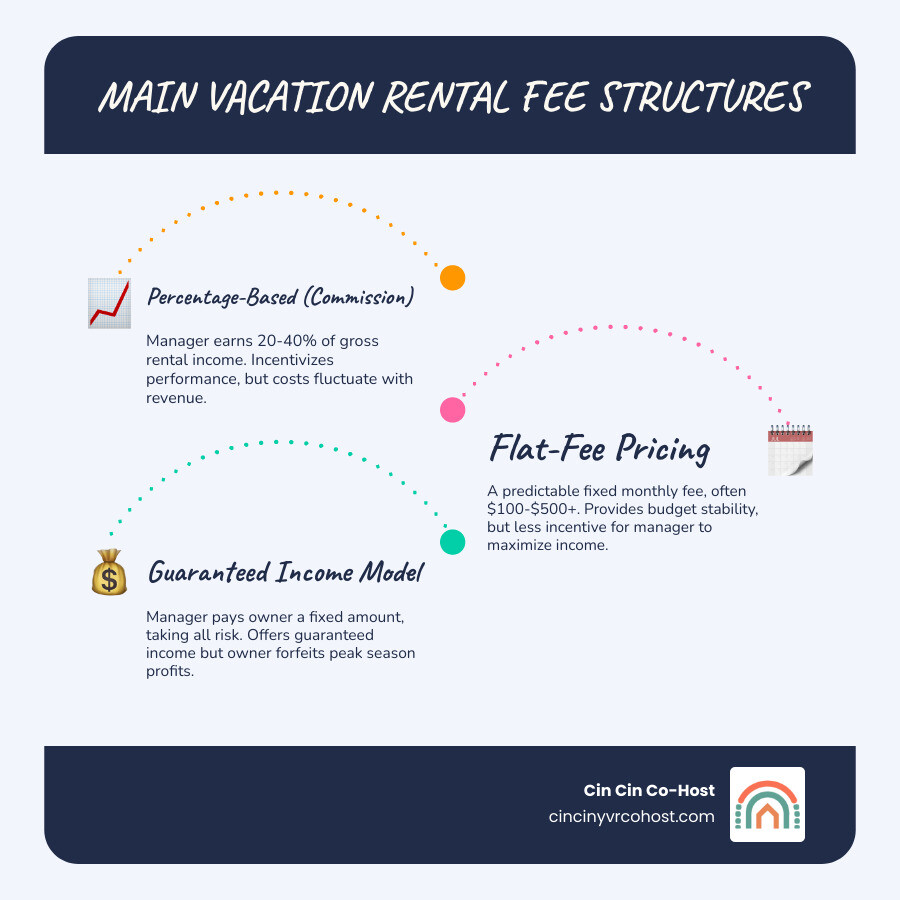
Deconstructing the Bill: Common Vacation Rental Management Fee Structures
When we talk about the cost of property management for vacation rental, we’re really diving into a world of different fee models. These structures are designed to align the property manager’s incentives with your goals as an owner, but they also reflect the level of service, market seasonality, and operational involvement required. Understanding these models is the first step to making an informed decision for your vacation rental property in Vancouver and the surrounding areas like Burnaby, Richmond, or North Vancouver.

The Commission (Percentage-Based) Model
This is arguably the most common and straightforward fee structure. In the commission model, the property manager takes a predetermined percentage of the gross rental income generated by your property. This means their earnings are directly tied to how much your property earns.
How it works: If your property generates $3,000 in rental income in a month and the agreed-upon commission is 25%, the property manager receives $750. The typical percentages we see in the industry for short-term rentals range anywhere from 10% to 40% or even 50% of your rental revenue, with many full-service companies falling into the 20% to 30% range of gross income.
Pros: We love this model because it truly incentivizes performance. When the manager earns more when your property earns more, they’re motivated to keep occupancy high, optimize pricing, and ensure guest satisfaction. It creates a partnership where everyone benefits from a successful rental. For more on how we maximize revenue, check out our guide on maximizing revenue.
Cons: The flip side is that your costs are variable. In slower seasons, the management fee will be lower, but so will your overall income. It might feel like you’re paying more during peak times, even though that’s when your property is generating the most revenue.
The Flat-Fee Pricing Structure
For owners who prefer predictability, the flat-fee pricing structure can be quite appealing. This model involves paying a fixed amount each month or annually, regardless of how much income your property generates.
How it works: You and the property manager agree on a set monthly fee—say, $300—and that’s what you pay, whether your property brings in $1,000 or $5,000 that month. Fixed rates can range from $100 to $500 per month or even more, depending on the property’s size, location (like a cozy condo in Gastown versus a spacious house in West Vancouver), and the services included.
Pros: The biggest advantage here is budget stability. You know exactly what your cost of property management for vacation rental will be each month, making financial planning much easier. It’s particularly attractive for properties with consistent occupancy.
Cons: This model can sometimes offer less incentive for the manager to go above and beyond to maximize your rental income. If they’re paid the same regardless of performance, their motivation might not be as directly aligned with securing every possible booking or pushing for higher nightly rates. For a deeper dive, explore what a flat-fee pricing structure for property management is and how it works.
The Guaranteed Income Model
This model is less common but offers the ultimate peace of mind for owners focused purely on consistent income. With a guaranteed income model, the property manager essentially leases your property from you and then manages it as a short-term rental.
How it works: The manager agrees to pay you a fixed, predetermined amount each month, regardless of bookings or occupancy. They take on all the risk and all the potential upside. For example, they might guarantee you $2,000 a month for your property.
Pros: The primary benefit is guaranteed income. You get a steady, predictable payment, insulating you from the fluctuations of the vacation rental market. This is great for budgeting and reducing financial stress.
Cons: The major drawback is that you forfeit any potential peak season profits. If your property could earn $5,000 in a busy summer month, but your guaranteed income is $2,000, the extra $3,000 goes to the management company. This model often prioritizes the manager’s interests by shifting the risk of fluctuating rental income to them. We typically advise caution with this model as it can significantly limit your earning potential, especially in high-demand markets like Vancouver.
What Your Management Fee Actually Buys You (And What It Doesn’t)
Understanding the fee structure is one thing, but knowing precisely what services are covered by that fee is another. It’s like ordering a fancy coffee – sometimes the whip cream is included, sometimes it’s extra! The distinction between full-service and partial-service management is crucial, and we can’t stress enough the importance of thoroughly reading your contract. Nobody wants unexpected surprises when it comes to their investment.

Services Generally Included in the Management Fee
When you pay a property management fee, especially for a full-service provider in the Vancouver area, you’re typically investing in a comprehensive suite of services designed to make your life easier and your property more profitable. These services often include:
- Listing Creation & Marketing: This covers crafting compelling listings for platforms like Airbnb, Vrbo, and Booking.com, complete with professional photography to showcase your property’s best features. Effective marketing is key to attracting guests and maximizing bookings in competitive markets like Metro Vancouver.
- Dynamic Pricing Strategies: A good property manager will use sophisticated tools to adjust your nightly rates based on market demand, seasonality (think ski season in North Vancouver or summer in Kitsilano), local events, and competitor pricing. This ensures you’re always getting the best possible rate. Learn more about dynamic pricing strategies.
- Guest Communication & 24/7 Support: From initial inquiries to post-stay reviews, your manager handles all guest communication. This includes answering questions, providing local recommendations, and being available around the clock for any emergencies or concerns, ensuring guests feel supported and valued.
- Booking & Calendar Management: Keeping your calendar perfectly synced across multiple platforms, preventing double-bookings, and managing reservation changes or cancellations is a full-time job. Your management fee typically covers this meticulous task.
- Handling Check-ins and Check-outs: This involves coordinating smooth arrivals and departures, providing clear instructions, and ensuring guests have access to your property. For details on how we manage these crucial touchpoints, see our guide on handling check-ins and check-outs.
- Minor Maintenance Coordination: While major repairs are usually extra, the management fee often includes coordinating minor, routine maintenance tasks and troubleshooting small issues that arise, ensuring your property remains in top condition.
Common Exclusions and Additional Costs
While the core management fee covers a lot, be aware of what typically isn’t included and might incur additional charges. These are the “hidden” costs that can quickly add up if you’re not prepared:
- Cleaning Fees: This is almost always a separate charge. While guests often pay a cleaning fee, the property manager might coordinate the cleaning service, and you might be responsible for costs between guests if the guest’s fee doesn’t cover the full cost, or for deep cleans. Cleaning costs vary significantly based on property size, location, and amenities – a studio apartment in Surrey will have a different cleaning cost than a large family home in Langley.
- Consumable Supplies & Stocking: Items like toiletries, coffee, paper towels, and other guest amenities usually fall outside the management fee. Some managers might charge a “stocking fee” or simply pass on the cost of purchasing these supplies, sometimes with a small markup (typically 1-5%).
- Major Repairs & Maintenance: While minor issues are often coordinated, significant repairs or renovations are almost always an additional expense. Property managers will typically get quotes and oversee the work, but the cost of the repair itself is yours. This also includes things like landscaping, pool maintenance, or specialized appliance repairs.
- Payment Processing Fees: When guests pay with credit cards, there are transaction fees involved, typically ranging from 3% to 5%. These are almost always passed directly to the owner and are not absorbed by the management fee.
- Deep Cleaning/Inspections: Beyond regular turnover cleans, properties often require periodic deep cleans or detailed inspections, especially after long stays or during seasonal changes. These are usually charged separately, often under $100 per charge, or sometimes drawn from a repair reserve fund.
- Onboarding or Initial Setup Fees: When you first sign up with a property management company, there might be an initial fee to cover the setup of your listing, professional photography (if not already done), market analysis, and administrative paperwork. These can range from free up to $300, depending on the company and the complexity of the onboarding process.
The Real Cost of Property Management for Vacation Rental: A Numbers Breakdown
Let’s get down to brass tacks: what does the cost of property management for vacation rental truly look like in numbers? It’s not just a percentage; it’s a dynamic interplay of your property’s earning potential, the chosen fee structure, and those pesky additional costs. Understanding this breakdown is crucial for budgeting and assessing profitability.
How to Calculate the Cost of Property Management for Vacation Rental
Calculating the total cost means looking beyond the headline percentage. We need to factor in everything. Let’s use an example for a hypothetical vacation rental in Coquitlam:
Sample Property Scenario:
- Monthly Rental Income (High Season): $4,000
- Monthly Rental Income (Low Season): $2,000
- Management Fee (Commission-Based): 25%
- Estimated Additional Monthly Costs (Cleaning, Supplies, Minor Maintenance): $300 (this is an average, it fluctuates)
Calculation Example (Commission Model):
- High Season:
- Rental Income: $4,000
- Management Fee (25% of $4,000): $1,000
- Additional Costs: $300
- Total Monthly Cost: $1,000 + $300 = $1,300
- Owner Net Income: $4,000 – $1,300 = $2,700
- Low Season:
- Rental Income: $2,000
- Management Fee (25% of $2,000): $500
- Additional Costs: $300
- Total Monthly Cost: $500 + $300 = $800
- Owner Net Income: $2,000 – $800 = $1,200
As you can see, the commission model means your management fee directly scales with your income. If you’re unsure about calculations, a property management fee calculator can be a helpful tool to estimate your potential costs and impact on net profit.
Average Costs in the Vacation Rental Industry
Across the industry, the average cost of property management for vacation rental typically ranges between 25% to 30% of your rental income for full-service management. However, this can fluctuate wildly, from as low as 10% (often for marketing-only services) up to 50% or more, depending on the level of hands-on service required.
Why short-term rental fees are higher than long-term: We often get asked why short-term rental management commands higher fees than long-term property management (which typically charges 8-13% of monthly rent plus a lease-up fee). The answer lies in the scope of work. Short-term rentals require:
- Frequent Turnover: Daily or weekly guest changes mean constant cleaning, inspections, and guest communication.
- 24/7 Guest Support: Guests expect immediate assistance at any hour.
- Dynamic Pricing: Constant monitoring and adjustment of rates.
- Extensive Marketing: Continuous efforts to keep the property booked.
- High Wear and Tear: More frequent maintenance and repairs due to diverse guest usage.
These tasks are far more intensive than managing a long-term tenant, hence the higher fees.
Local market impact (e.g., Vancouver): In a dynamic and competitive market like Vancouver, Metro Vancouver, Richmond, or Port Coquitlam, local market knowledge is invaluable. The specific location of your property within these areas can also influence fees. A property manager with deep local ties can leverage their network for better service providers, faster response times, and custom marketing strategies, justifying their fee. They understand local regulations and tourist demand, which can fluctuate significantly.
Weighing the Pros, Cons, and Cost-Saving Alternatives
Deciding whether to hire a property manager for your vacation rental is a big step. It’s a balance between how much control you want, how much time you have, and how much you’re willing to pay. It comes down to the value proposition: is the cost of property management for vacation rental worth the benefits it brings?
The Pros and Cons of Hiring a Property Manager
Let’s lay out the good, the bad, and the slightly inconvenient:
Pros of Hiring a Property Manager:
- Maximized Revenue: Professional managers use dynamic pricing and broad marketing strategies to boost occupancy and nightly rates, often leading to higher overall earnings than self-management.
- Time Savings: This is a huge one! They handle everything from guest inquiries to cleaning, freeing up your precious time. Imagine enjoying your weekends instead of coordinating turnovers.
- Local Expertise: A good manager in Vancouver, Surrey, or Pitt Meadows knows the local market inside out – what guests want, local events, and the best local service providers. This local knowledge is hard to replicate.
- Vendor Networks: They have established relationships with reliable cleaners, maintenance crews, and other service providers, often securing better rates and faster service.
- Reduced Stress: Say goodbye to late-night guest calls, maintenance emergencies, and the endless to-do list. A manager takes on the burden, giving you peace of mind.
Cons of Hiring a Property Manager:
- Reduced Net Income: This is the most obvious one. Their fees directly reduce your take-home profit. You’re trading a percentage of your income for their services.
- Loss of Control: While you still own the property, you delegate daily operations. This means less direct control over guest interactions, pricing decisions, and maintenance choices.
- Potential for Impersonal Service: With larger management companies, your property might just be one of many, potentially leading to less personalized attention for you and your guests. This is where a hands-on co-host model shines.
- Unexpected Expenses: Even with a clear contract, additional fees for specific services can crop up, chipping away at your profits if not fully understood upfront.
How to Potentially Save on Management Costs
If the full cost of property management for vacation rental seems a bit steep, there are ways to trim expenses or find a more cost-effective solution:
- Self-Management: If you have the time, live close to your property in Langley or Richmond, and enjoy the hands-on aspects, managing your own rental can save you all management fees. However, be realistic about the time commitment and stress involved.
- Using Vacation Rental Software and Automation Tools: For self-managers, software can automate many tasks like guest communication, calendar syncing, and dynamic pricing. This can replicate many services of a manager at a fraction of the cost.
- Automating with Smart Technology: Integrating smart locks, thermostats, and noise monitors can streamline operations and reduce the need for physical presence, saving time and potentially reducing management fees if your manager needs to do less on-site. Explore how we leverage smart technology to revolutionize hosting.
- Negotiating Contract Terms: Don’t be afraid to negotiate the commission percentage, included services, or contract length. Property managers might be flexible, especially for high-performing properties or during slower seasons. Always understand what you will be paying for before working with a property manager.
- Choosing A-La-Carte Services: Some companies offer partial management or co-hosting services where you pick and choose what you need help with (e.g., just marketing, or just guest communication). This can be a good middle ground if you want some support without the full-service price tag.
Frequently Asked Questions about Vacation Rental Management Costs
We know you have questions, and we’re here to answer them! Navigating the financial landscape of vacation rentals can be tricky, but clarity is key to making the best decisions for your property.
How much profit should you make on a vacation rental property?
A common rule of thumb is to aim for a profit margin of 20% to 30% after all expenses are covered, including the cost of property management for vacation rental. This means if your property generates $10,000 in monthly revenue, and after all expenses (including a 30% management fee), you should ideally net $2,000 to $3,000 as profit.
Factors that significantly affect profit include:
- Location: Properties in high-demand areas like Downtown Vancouver or popular tourist spots in North Vancouver tend to yield higher returns.
- Occupancy Rates: High occupancy is crucial. A good property manager or co-host will prioritize this through effective marketing and dynamic pricing.
- Seasonal Adjustments: Your profit will naturally fluctuate with high and low seasons.
- Expense Management: Keeping a close eye on cleaning, maintenance, and utility costs is vital.
It’s important to distinguish between gross income (total revenue) and net income (what you actually take home after all costs). A higher gross income doesn’t always mean a higher net profit if expenses are out of control.
What are the key factors to consider when choosing a property management company?
Choosing the right partner is paramount. Here are the key factors we believe you should consider:
- Service Level (Full vs. Partial): Do you need someone to handle everything, or just specific tasks? Clarify their offerings and ensure they match your needs.
- Fee Structure Alignment: Understand their fee model (percentage, flat-fee, guaranteed income) and ensure it aligns with your financial goals and risk tolerance. Ask for a clear breakdown of all fees.
- Local Market Knowledge: Especially in a diverse region like Metro Vancouver, from the busy city to the tranquil suburbs of White Rock, local expertise is non-negotiable. Do they understand the specific appeal and regulations of your property’s location?
- Technology Use: Do they leverage modern property management software, dynamic pricing tools, and smart home technology to optimize your listing and streamline operations?
- Contract Terms: Scrutinize the contract for duration, termination clauses, and any hidden fees. Ensure all fees are clearly itemized and explained. Protecting your business starts with solid agreements; learn more about property management agreements.
- Reputation and References: Check testimonials and ask for references from other property owners. What do others say about their service, communication, and results?
What is the difference between a property manager and a co-host?
While both aim to help you manage your vacation rental, there are distinct differences, especially in the Vancouver market:
- Property Manager Role: Typically, a property management company (especially larger ones) handles all aspects of your rental, from marketing to maintenance, for a significant percentage of your income. They often have a standardized approach, which can sometimes feel less personal.
- Co-host Role: A co-host, particularly one like Cin Cin YVR CoHost, often offers a more personalized, hands-on, and team-driven approach. We work closely with owners, investors, and remote hosts to manage properties. Our focus is on maximizing income and providing a hassle-free experience with a personal touch. We often bring flexibility and a deeper understanding of individual property needs. We’re not just managing a property; we’re co-hosting your success. For insights into the top services a co-host should offer, check out our guide.
Conclusion: Finding Value Beyond the Price Tag
Understanding the cost of property management for vacation rental is more than just looking at a number; it’s about evaluating the value and peace of mind you receive in return. We’ve explored the various fee structures, what services you can expect, those pesky additional costs, and how to calculate the real impact on your bottom line.
The decision to hire a property manager or co-host, and which fee structure to choose, depends on your personal goals, your available time, and your desired level of involvement. A good management partner can transform your vacation rental from a time-consuming chore into a truly passive and profitable investment. They bring expertise, efficiency, and local market knowledge that can significantly boost your earnings and guest satisfaction.
For a personalized, hands-on approach in Vancouver, Metro Vancouver, and the surrounding areas like Burnaby, Richmond, North Vancouver, West Vancouver, Coquitlam, Port Coquitlam, Langley, Surrey, and Pitt Meadows, Cin Cin YVR CoHost offers end-to-end management custom to maximize your income and provide a hassle-free experience. We pride ourselves on being a trusted partner, ensuring your property thrives in this vibrant market.
Ready to open up your property’s full potential without the stress? Explore Our Services and let’s discuss how we can help you achieve your vacation rental goals.